Updated Lunar Dust Mitigating EVA Cuff Checklist
For Lunar Missions
This design challenge project, sponsored by Technology Collaboration Center, was accomplished by a dedicated duo of two individuals.
The objective of the project is to create a comfortable secured EVA Cuff Checklist that includes a dust-mitigating feature and enclosure system. This solution must keep the dust out with a separation rate, i.e., the ratio of removed dust to initial dust amounts, of 80%, and contain procedures and reference information for performing EVA tasks.
Project Type
Product Design / EVA Tool Design / Wearable
Team
Lyla Nam, Jayce Kim
Contribution
Product Design, 3D Modeling and Rendering
What is a
Cuff Checklist ?
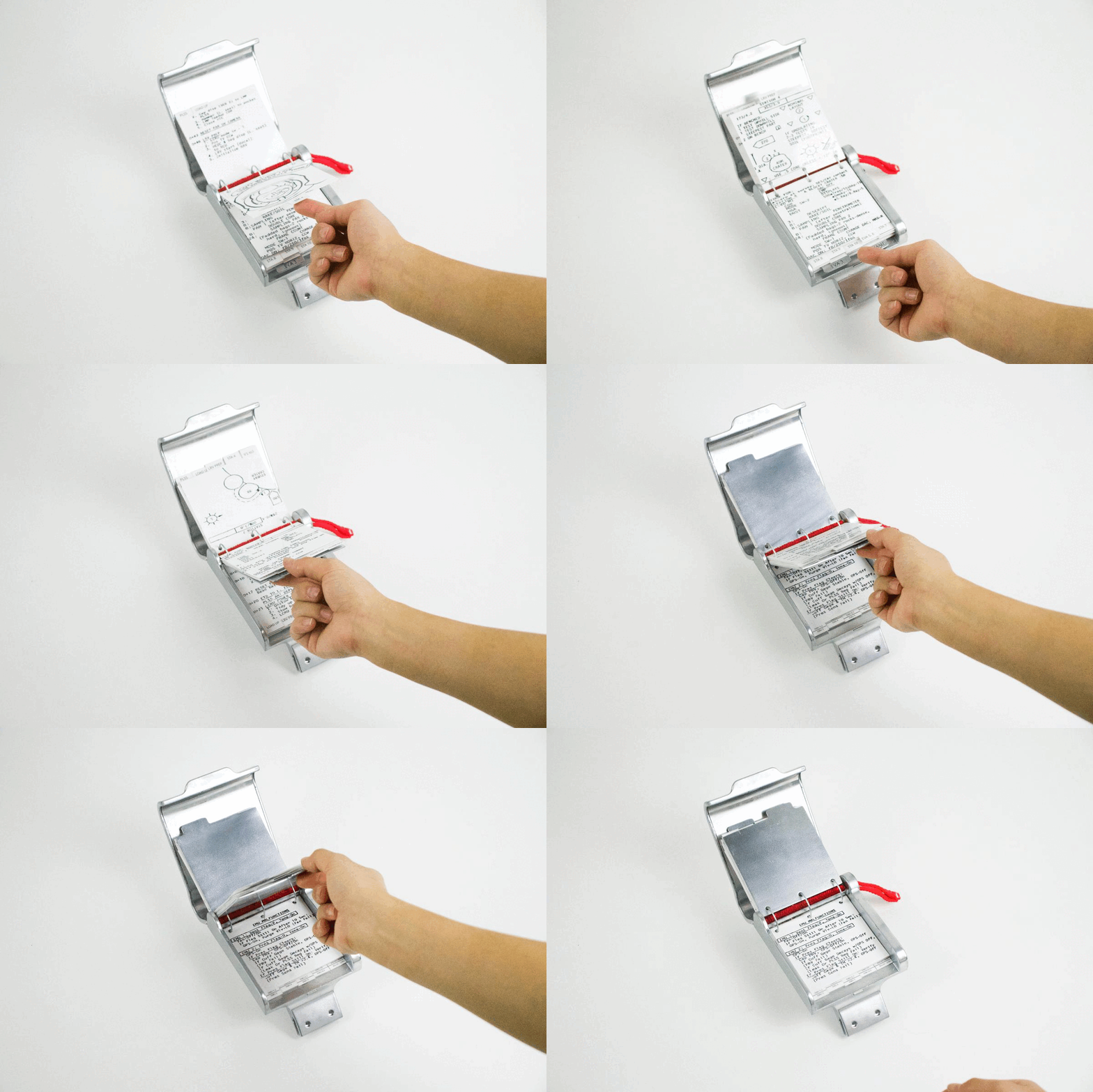
The Cuff Checklist is a reference card that contains twenty-five double-sided pages of text-based procedures and graphics for reference information for performing EVA tasks that are organized by indexing tabs. It is held by copper beryllium leaf spring and CRES coil spring binders attached to a wristband made of Aluminum, steel Twistoflex with an Orthofabric cover that has an adjustable velcro strap.


Problem
-
Highly vulnerable to dust collection
-
Causes the Human Landing System, the Habitat, and the lunar pressurized rover to be exposed to dust that is brought inside by astronauts
-
Leading to major health concerns
-
Deleterious effects on engineering systems.
Design Research
To successfully mitigate lunar dust, it is important to understand the characteristics of lunar dust, as well as the interaction between the EVA cuff checklist, the EMU suit, and the astronaut during extravehicular activities.

Insights


Moondust Characteristics
Lunar dust grains are coated with an iron-rich glass layer that makes them magnetic, and they are positively charged by the environment and friction, giving them strong electrostatic attraction that makes them easily stick to surfaces.
Dexterity Limitations
Pressurized and tough EMU gloves reduce strength and dexterity performance.
Mobility Limitations
Pressurized EMU suits create resistance and restrict movement.
High dust collection areas
High dust collection between the checklist wristband and spacesuit and between Gauntlet (glove bump) and spacesuit.
Underutilized Checklist
Astronauts perform 1 EVA per day on a lunar mission, leaving the checklist unused most of the time.
Design Approaches
Passive approaches to mitigate dust
Easy manipulation of the checklist
Minimize gaps that are prone to dust collection

User Testing & Design Development
2 experiments were done to design a more effective dust-mitigating and ergonomic checklist.
1. Effectiveness of magnet when collecting lunar dust

Objective:
Tested how magnets effectively attract lunar dust.
Results:
Lunar dust attracts dust when it is close enough and larger dust particles are easier to collect.
2. Ergonomic Fanning Method


Objective:
Conducted a subjective rapid user test to know which fanning method is more comfortable.
Results:
70% (out of 10) commented that flipping upwards is more ergonomically comfortable than sideways.


Final Design
Self-cleaning System
Magnetic attraction
Micro Precision Fit
Reduces gap between EVA suit & wristband


Dust Protection
Cover keeps pages closed
Manual Cleaning System
Removable brush and electrostatic fabric

Key Features

Dust Mitigating Cover
Astronauts perform 1 EVA per day on a lunar mission, leaving the checklist unused most of the time. Dust mitigating cover helps keep the pages clean when unused and keeps pages within astronauts' range of vision.

Cleaning Brush
2-way brush (Anti static brush + bristle brush) for cleaning dust off pages.

Micro Adjustable BOA Dial & Cover
BOA Dial provides precision fit for each astronaut. The elastic spandex cover prevents the BOA Dial to be exposed to lunar dust. A wide handle loop helps astronauts easily pull up/down with one finger.


Aluminum Top Case
Magnet
3 Ring Binder
Alimunim Frame
Hinge
Wristband Tip
Coated Canvas Wristband
Spandex BOA Dial Cover
BOA Dial
Magnetic Snap
Socket Head Cap Screw
Anti-static Brush
Production and CMF
Final Prototype